- Foreign ministers of Pakistan, Saudi Arabia, Egypt, Türkiye discuss regional crises in Istanbul
- Ministers blame Israeli occupation as “fundamental source” of instability in region and beyond
ISLAMABAD: Pakistan, Saudi Arabia, Türkiye and Egypt this week condemned the recent attacks by the Houthi rebels against the civilian and economic infrastructure in the Kingdom in a joint statement, calling on the militia to immediately cease all attacks and return to the political process.
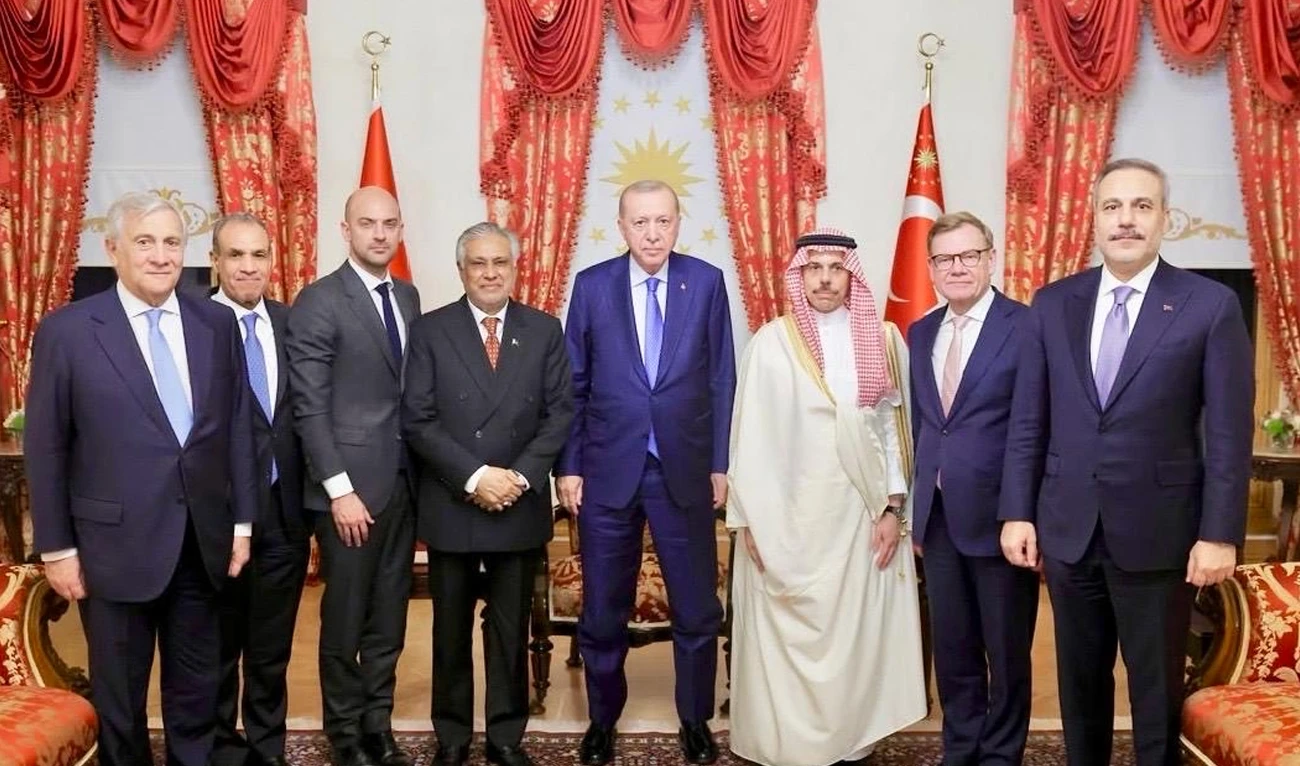
The joint statement was issued following a meeting between the foreign ministers of the four nations, who are part of the R4 or Regional Four group, in Istanbul. The R4 ministers then separately held a meeting with the foreign ministers of France, Germany, Italy and Britain to discuss tensions around the Strait of Hormuz, the conflict in Yemen, the Palestinian issue and other regional crises.
The R4 statement comes amid the intensification of attacks by the Yemen-based, Iran-backed Houthis against Saudi Arabia in recent weeks, and renewed fears of a wider regional conflict after reports that US and Israeli forces had drawn up plans for possible strikes against Iranian nuclear facilities, energy infrastructure and missile capabilities following the US midterm elections on Nov. 3.
“They expressed their full solidarity with the Government of Yemen and the Kingdom of Saudi Arabia, and called on the Houthi militia to immediately cease all military actions, threats and attacks, and to return to the political process in good faith,” the joint statement said on Friday.
The increase in attacks by Houthi rebels follows the breakdown of an uneasy four-year truce between the government of Yemen and Houthis in July, compounded by wider regional escalation between the US and Iran. The conflict in Yemen, which erupted in late 2014 when the Houthis seized Sanaa, has claimed hundreds of thousands of lives and plunged the Arabian Peninsula’s poorest nation into one of the world’s worst humanitarian crises.
The ministers condemned attacks on international commercial shipping in the Red Sea and Bab Al-Mandab Strait, and warned that continuing restrictions on freedom of maritime navigation threatened global supply chains and shipments of oil, food and fertilizers, with consequences that extend far beyond the Middle East.
The R4 statement blamed Israeli occupation in the Middle East as the “fundamental source of instability in the region and beyond,” saying that Israeli policies create a deep sense of injustice in global public opinion.
“They called for the early implementation of the two-state solution in accordance with the relevant UN resolutions,” the statement added.
The R4 group demanded a halt to the expansion of Israeli settlements in the occupied West Bank and East Jerusalem, an immediate end to attacks by settlers, and the uninterrupted delivery of humanitarian assistance in Gaza, along with reconstruction efforts in the territory.
The ministers also called for renewed diplomatic efforts to prevent any further escalation of the US-Iran war, and insisted that the crisis be resolved “exclusively through dialogue and diplomacy.”
They reaffirmed support for the Islamabad Memorandum of Understanding, an interim peace deal signed by Washington and Tehran in June to end the war, and urged both sides to work toward a lasting, negotiated settlement.
’DIALOGUE, DIPLOMACY, DE-ESCALATION’
Pakistan’s foreign office separately shared a joint press release about the R4 group’s meeting with the foreign ministers of France, UK, Italy and Germany.
The press release said both sides discussed the US/Israel-Iran conflict, Israeli-Palestinian conflict, increasing Houthi militia attacks against Saudi Arabia and Yemen, as well as tension in the Straits of Hormuz and Bab El Mandab and the Black Sea.
“The Ministers agreed on the urgent need to address regional conflicts through dialogue, diplomacy and de-escalation,” the joint statement said.
“In accordance with the relevant UN Resolutions, they emphasized the need for finding lasting negotiated solutions to all outstanding conflicts.”
It said the ministers agreed to continue dialogue in the same format to prevent conflicts and advance peace and stability in the region.